Caritas Poland has been supporting Ukraine for 12 years. Its humanitarian and development initiatives, as well as the current situation in the country, were discussed with Vatican News by Nina Mocior, an expert in humanitarian and development assistance at Caritas Poland.
“A Parcel for Ukraine”
Caritas Poland has been providing assistance to Ukraine since 2014, following Russia’s annexation of Crimea and the outbreak of the war in Donbas.
The scale of that support increased dramatically in 2022, when Russia launched its full-scale invasion of Ukraine. It was then, Mocior recalls, that Caritas Poland launched its “A Parcel for Ukraine” campaign.
Caritas Poland collected and transported packages containing food and hygiene products. “The parcels contained enough essential supplies to last for several weeks,” Mocior says. “It was a very beautiful initiative. In an act of solidarity, sympathy and compassion for Ukrainians, donors would put not only basic necessities into the parcels, but also various gifts, such as toys for children, letters with good wishes and messages of spiritual support.”
In total, more than 90,000 Ukrainian families received parcels from Poland.
“Family to Family”
The origins of the “Family to Family” programme lie in Polish parishes, where financial assistance was collected for people in need. The programme was launched ten years ago to support vulnerable families in Syria, and was later expanded to Palestine and Lebanon. Since 2022, it has also included Ukraine.
Under the programme, families living in poverty or facing particularly difficult circumstances receive financial assistance.
“In Ukraine, we currently provide this support in the form of grants — either for training or to help people start their own small businesses. We support agricultural activities and entrepreneurship. Our aim is to help people become self-reliant and rebuild their lives,” Mocior explains.
“Family at the Centre”
War causes not only material losses. It also has a profound impact on people’s mental health, Mocior stresses.
The “Family at the Centre” programme has been operating in Ukraine for nearly three years. It is currently implemented in four cities: Kamianets-Podilskyi, Zhytomyr, Odesa and Kharkiv.
“We run Family Support Centres where we help veterans and their families. The project is funded from the state budget as part of Polish development cooperation implemented by the Polish Ministry of Foreign Affairs,” Mocior says.
Each centre has psychologists on staff. Demobilised veterans returning home — and, naturally, their families — often need psychological and psychosocial support.
“We make sure they have a place where they can meet and spend time together, so that they integrate rather than isolate themselves,” Mocior explains.
One particular aspect of the programme in which she is personally involved is a series of camps for veterans and their families. These are intensive, seven-day programmes designed to help couples rebuild their relationships, while also providing therapy and rehabilitation for veterans.
“We conduct both group and individual sessions,” she says.
The Problem of Isolation
Mocior co-leads these camps and is preparing to travel to another one in the coming days. She says many women are afraid to ask their husbands about what happened to them during the war.
“It is very difficult for them to talk. Veterans say that returning home is genuinely extremely difficult. They often do not know how to start a conversation or express their needs, so they withdraw and isolate themselves. This can cause a mental health crisis to become much more severe,” she says.
Mocior also points out that some veterans return from the front with deeply traumatic memories that they cannot forget. In many cases, time alone is not enough to heal these wounds.
Many veterans suffer from post-traumatic stress disorder, and a significant proportion have sustained physical injuries during the war.
“I’m No Longer of Any Use”
“Soldiers are often sent home against their will for various reasons, including health problems. This can very often cause psychological trauma,” Mocior says. “A veteran may feel that they have failed, that they were unable to cope, that they were too weak and that they are no longer of any use. This is often accompanied by what is known as survivor’s guilt.”
The return home can therefore be an extremely difficult experience.
“The challenge is enormous. Suddenly, we have an entire new social group with very specific needs: soldiers, veterans and their families, all carrying the trauma of war. There is a need for specialists with experience in this kind of work,” Mocior explains.
“I have been working with war trauma for 15 years, so in a way I am a natural resource for Caritas Poland’s work in Ukraine. I train specialists, provide therapy and co-lead the camps,” she adds.
Supporting Ukrainian Children
Children are the main target group of the Family Support Centres.
The centre in Kharkiv operates underground, in a bomb shelter. Because of the war, many children in the city are studying remotely. In Kharkiv, as in Odesa, air-raid alerts are frequent.
For many children, the Caritas centre, where they can receive psychological support, is also their only opportunity to meet their peers in a safe environment.
Their needs vary widely
“Many of these children were born during the war or shortly before it began. They do not know any other, normal reality,” Mocior explains. “They are safe in the shelters. They can study and play there, especially since many children from displaced families do not have their own toys.”
Caritas also organises recreational activities, as well as meetings for parents and entire families, helping them cope with the trauma of war.
“War affects the entire family system,” Mocior says.
Social Laundries
Caritas Poland has also launched a programme of social laundries in cities with large populations of internally displaced people, including Kyiv, Lutsk and Vinnytsia.
“These laundries are particularly helpful for elderly people and those who are unable to live independently and who, because of power shortages or irregular electricity supplies, cannot use their own washing machines,” Mocior explains.
“Very often, our laundries are the only places in the city where these people can come to wash and dry their clothes. People frequently come to wash bedding, for example, because they have bedridden family members at home whose sheets need to be changed regularly.”
Mocior hopes that the laundries and drying facilities established as part of Caritas Poland’s winter assistance programme will continue to serve local communities for years to come.
“These laundries and drying facilities will probably continue to help people through the next several winters,” she says.
As part of the same project, food parcels are distributed to families in several cities close to the front line, while hygiene packages are provided to elderly people and children.
In Kyiv, warm meals were also distributed to homeless people and others in need during the winter months.
Caritas Poland provides assistance to Ukraine in close cooperation with local Caritas organisations of both the Roman Catholic and Greek Catholic Churches.
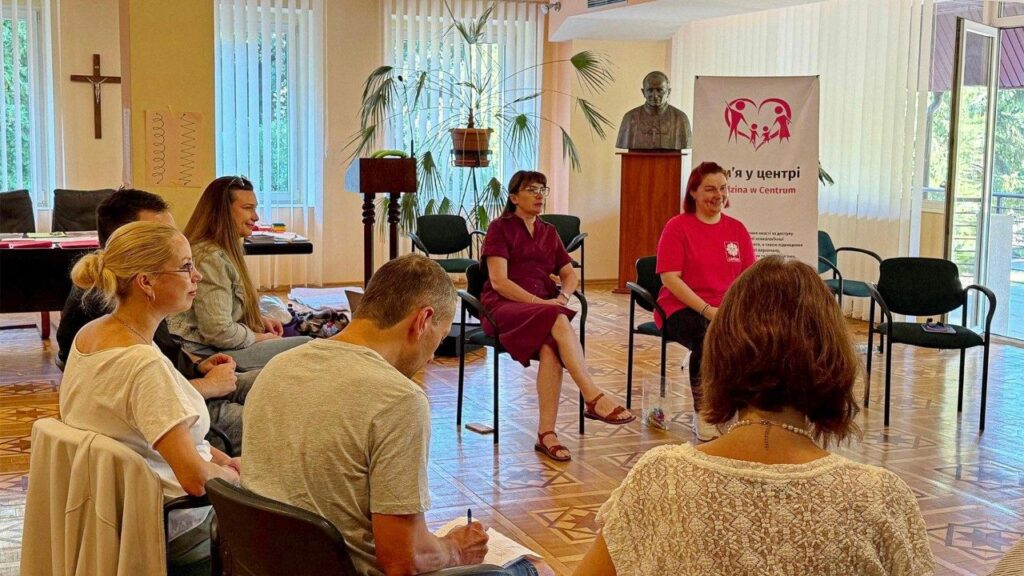
Photo credit: Caritas Poland
Family News Service / Piotr Kowalczuk