As Vatican News informs, Caritas Poland (Caritas Polska) provided assistance to more than 1.1 million people in Poland and abroad in 2025, according to the organization’s latest report. The total value of the aid exceeded PLN 1.2 billion, including more than PLN 52 million allocated to international programs carried out in 34 countries across five continents.
“If we want to provide effective assistance in such a dynamically changing world, we must constantly transform and improve our aid models,” said Father Janusz Majda, director of Caritas Poland.
More than 760,000 people assisted in Poland
In Poland, Caritas provided support to more than 760,000 people, including seniors, children, people with disabilities, people experiencing homelessness, and patients receiving hospice and long-term care.
The scale of Caritas Poland’s operations is made possible through the coordination of its 45 diocesan branches. More than 12,000 employees, supported by some 70,000 volunteers, are involved in the organization’s daily work. Caritas operates more than 1,300 facilities across Poland, as well as around 1,200 food distribution points.
“Thirty-five years of operation have allowed us to gain extensive experience, but they have also reinforced our belief that, if we want to help effectively in such a dynamically changing world, we must constantly transform and improve our aid models,” Father Majda said.
Tackling hunger and food waste
Combating hunger and food waste was among Caritas Poland’s key priorities in 2025. According to Poland’s Central Statistical Office (GUS), nearly 2 million people in the country live in extreme poverty.
Through its “Caritas Pantry” initiative, the organization distributed more than 6,000 food items to people in need. In total, tons of food reached more than 400,000 beneficiaries, while more than 1.2 million food parcels were distributed nationwide.
More than 72,000 people received assistance at emergency aid points across Poland. Caritas also continued to support communities affected by the floods of September 2024, allocating more than PLN 27 million for construction materials and the reconstruction of damaged buildings.
Support for seniors, children, patients and people experiencing homelessness
Caritas also continued to develop nationwide programs aimed at groups particularly vulnerable to social exclusion. Nearly 70 facilities provided support under these programs, benefiting almost 120,000 people. More than 11,000 seniors took part in dedicated assistance programs. More than PLN 25 million was allocated to the “For Everyday Shopping” campaign, through which people in need received prepaid cards to purchase essential goods at Biedronka stores.
Healthcare and rehabilitation remained another major area of activity. Caritas Poland operated 38 home hospices and 14 inpatient hospices. Its inpatient facilities cared for nearly 2,500 people, while home hospices provided care to almost 4,000 patients in their own homes.
More than 77,000 patients benefited from 62 specialized rehabilitation centers operated by Caritas’s diocesan branches. The organization also runs 125 rehabilitation equipment rental centers nationwide, providing items such as orthopedic beds, wheelchairs and oxygen concentrators. Nearly 83,000 people benefited from facilities supporting people with disabilities.
Caritas also provided assistance to people experiencing homelessness through 47 shelters and 23 bathhouses. Children and young people were another focus of its work. More than 7,700 children received care in Caritas-run facilities, including centers, nurseries and schools. Scholarship programs supported 1,330 students, while more than 19,000 children took part in summer camps organized by Caritas.
International aid reaches 34 countries
Caritas Poland expanded its international operations in 2025. More than PLN 52 million was allocated to programs outside Poland, reaching over 370,000 people through 76 projects. The organization carried out humanitarian operations in seven of the world’s 10 largest crisis hotspots: Afghanistan, Yemen, Syria, the Gaza Strip, Ukraine, South Sudan and Ethiopia. Through national Caritas organizations, Caritas Poland implemented aid and development projects in 34 countries across five continents. It also supported initiatives led by Polish missionaries working with local communities in 15 countries.
Middle East, Ukraine and Africa
Caritas Poland allocated PLN 21.6 million to assistance for victims of armed conflicts in the Middle East. In September 2025, it launched a special program providing medical care and humanitarian assistance to residents of the Gaza Strip. At the same time, its “Family to Family” program continued in Syria and Lebanon, with funding exceeding PLN 11.3 million.
Alongside emergency humanitarian assistance, Caritas is placing increasing emphasis on economic inclusion and helping people regain the ability to support themselves. A total of 189 beneficiaries, mainly micro-entrepreneurs in some of the world’s most vulnerable regions, received such support. One example is a program launched in the West Bank to support micro-enterprises and family businesses. The initiative aims to help people affected by conflict rebuild their livelihoods and provide for their families independently. In Ukraine and Ethiopia, specialized psychological support was among the key elements of Caritas Poland’s response to the profound trauma caused by war.
Financing, loneliness and mental health among key challenges
According to the Caritas Poland report, effective humanitarian assistance today requires not only adequate funding but also efficient human resources management and close cooperation with public authorities and the private sector. The organization warns that one of the major challenges in the coming years will be maintaining the current scale of assistance amid rising poverty and increasingly complex and overlapping crises. Caritas also points to growing social challenges, including loneliness, changing family structures and mental health crises affecting different groups, particularly children and young people.
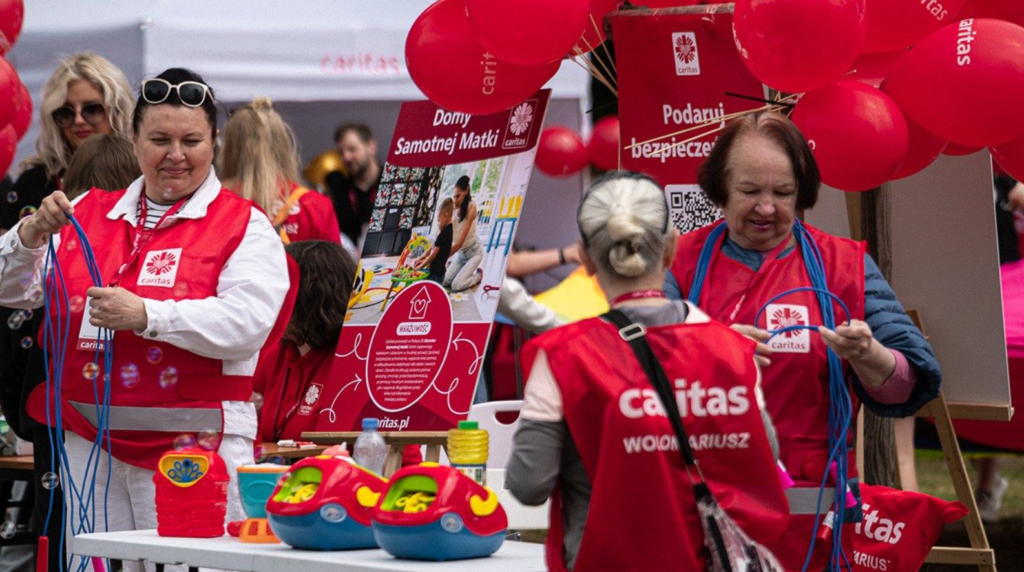
Photo credit: Caritas Poland
By Caritas Poland / s. Amata J. Nowaszewska CSFN / Piotr Kowalczuk