TikTok feeds, algorithms over verified sources, and ChatGPT for fact-checking—a new report to the Polish Parliament paints a troubling picture. Researchers warn that teenagers now inhabit a world of algorithmic half-truths, leading many to question whether truth exists at all. The findings, they stress, pose a real threat to national security.
Algorithms as the New Gatekeepers
“Youth and young adults are the groups most exposed to disinformation,” said Paweł Rabiej, presenting the key findings of Between the Fact and the Feed, a report by the Korczak University’s Center for Information Society Analysis.
The qualitative study interviewed 30 teens aged 14–19 from six locations. Though interested in global affairs, they rarely seek information intentionally; instead, they consume what appears in their 'For You’ feeds—mainly brief TikTok and YouTube videos.
Researchers note that political news, life hacks, and cat memes appear in a single continuous scroll. “This blurs the hierarchy of what’s important,” explained Maria Wierzbicka-Tarkowska. She added that video is now the preferred format for receiving information.
The report cites research by Gloria Mark of the University of California, showing that the average time spent focusing on a screen has sharply declined — from 2.5 minutes in 2004 to just 47 seconds in 2023. “Reading is tiring, and diving into longer texts feels like an effort — something we sometimes can’t muster when everything already feels exhausting,” said one participant, quoted by Dr. Anna Buchner.
Fact-Checking: Comments and ChatGPT
Teens claim to verify information but often do so intuitively or with AI. 'ChatGPT is popular, so I use it. I think it’s reliable,’ one told researchers. 'Young people often accept what chatbots say,’ Dr. Buchner warned, noting their views on truth are also concerning.
Comments and user reactions also play an outsized role. As one interviewee explained: “Most people think that if someone is followed by a lot of users, then they must be trustworthy — but that’s not always the case.”
Truth on Shifting Sands
The study shows that young people no longer see truth as a fixed fact but as a process — something to “grind through, verify and filter through themselves.” At the same time, they feel overwhelmed by half-truths and fake news. The result is a growing sense of helplessness. “They view truth as fundamentally unstable,” said Dr. Buchner.
Conspiracy Theories as Entertainment
Participants also discussed conspiracy theories, often treating them as harmless. But co-author Dr. Konrad Ciesiołkiewicz noted that adolescents and young adults are far more exposed to disinformation — and more likely to believe conspiracy narratives — than older groups.
This is confirmed by research from Jagiellonian University (2023), conducted after the pandemic and following the outbreak of full-scale war in Ukraine, as well as by multiple international studies showing that minors are consistently the most targeted and most susceptible group. In one U.S. study cited by Dr. Ciesiołkiewicz, 80% of social media users encounter conspiracy content at least weekly, and 81% admit to having believed it at least once.
Some young people consider such theories “unlikely but possible”; others treat them as intriguing curiosities — compelling stories that “get good clicks.” “Something doesn’t have to be 100% true to grab your attention,” said Katarzyna Fereniec-Błońska.
Researchers Sound the Alarm: Act Now
The authors call for immediate systemic measures: mandatory media and information literacy education, critical thinking training, and stronger regulation of digital platforms.
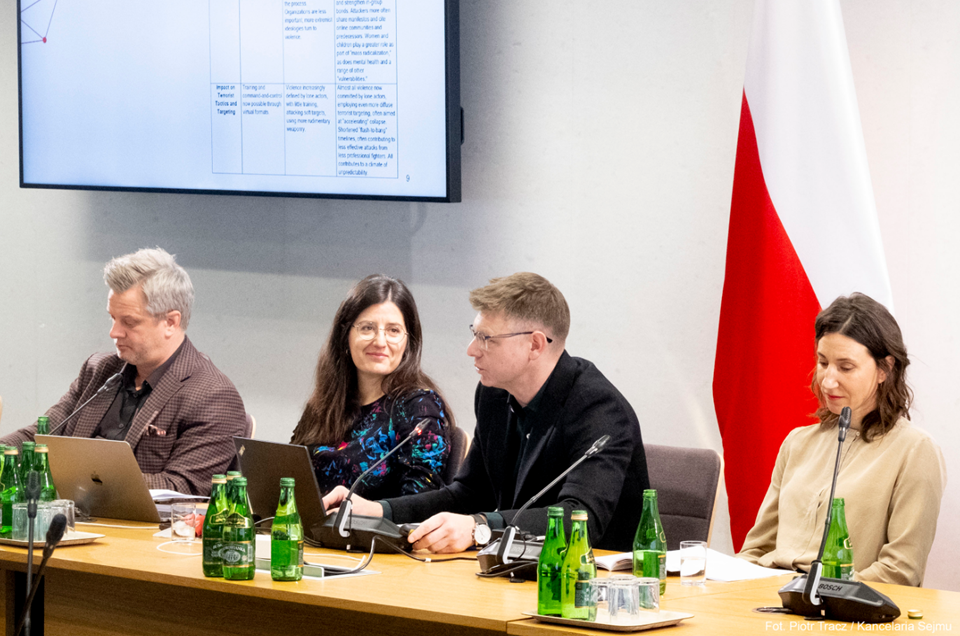
Piotr Tracz / Chancellery of the Sejm / sejm.gov.pl
Family News Service